Categories
blog

California SB 35: What Contractors Need to Know About Prevailing Wage & Compliance

California Senate Bill 35 (SB 35) reshaped the approval process for multifamily housing developments by introducing a streamlined, ministerial approval pathway for qualifying projects. While the bill is primarily viewed through a housing development lens, it carries significant compliance implications for contractors, especially those operating in the prevailing wage space.

Below is a practical guide to SB 35 focused on what contractors, subcontractors, and compliance teams need to know to stay compliant and audit ready.

Important Update: SB 35 Was Extended and Amended by SB 423

Before diving into compliance details, it’s worth flagging a development that changes how this law should be understood today: SB 35 is no longer a standalone statute operating on its original 2017 terms.

In October 2023, Governor Newsom signed SB 423 (Wiener), which took effect January 1, 2024, and substantially amended the streamlined ministerial approval process originally created by SB 35 (codified at Government Code § 65913.4). Some jurisdictions and planning departments now refer to the process as “SB 423 (formerly known as SB-35).”

Key changes contractors should know about:

  • The sunset date was extended a decade. SB 35 was originally set to expire on January 1, 2026. SB 423 pushed that expiration to January 1, 2036.
  • The old blanket labor standard was replaced with a tiered structure. Previously, SB 35 applied a single objective standard requiring prevailing wage and use of a skilled and trained workforce across covered projects. SB 423 restructured this into size- and height-based tiers (detailed in the Skilled and Trained Workforce section below), rather than a one-size-fits-all requirement.
  • A small-project exemption was added. Projects of 10 units or fewer that are not otherwise a public work are exempt from the prevailing wage, apprenticeship, and healthcare expenditure requirements entirely.
  • The coastal zone exclusion was removed, expanding the geographic reach of projects eligible for streamlined approval.

For contractors and compliance teams, the practical takeaway is this: prevailing wage still applies broadly, but which additional labor standards apply (skilled and trained workforce, apprenticeship utilization, healthcare expenditures) now depends on specific project size and building height thresholds rather than a blanket rule. The sections below reflect the current SB 423-amended framework.

What Is SB 35?

SB 35 allows qualifying multifamily housing projects to bypass discretionary approvals and move through a streamlined, by-right approval process if they meet objective zoning and affordability requirements.

Key features include:

  • Ministerial (non-discretionary) approvals
  • Strict timelines for local agency review (60–90 days depending on project size)
  • Requirements tied to affordability thresholds and housing production goals
  • Applicability to jurisdictions that fall behind on regional housing needs (RHNA)

Prevailing Wage Requirements Under SB 35

SB 35 explicitly ties streamlined approval eligibility to prevailing wage compliance.

When Prevailing Wage Applies

Under SB 35, developers must certify one of the following:

  • The project is a public work, OR
  • All construction workers will be paid at least the general prevailing wage for the applicable trade and location

This applies even when the project is privately funded.

Contractor Responsibilities

For contractors and subcontractors, this means:

  • Paying DIR-determined prevailing wage rates
  • Ensuring apprentices are paid the correct apprentice wage rates
  • Flowing prevailing wage requirements down to all subcontractor tiers
  • Including prevailing wage clauses in all contracts
  • Skilled and Trained Workforce requirements (if applicable)

Failure to comply can lead to:

  • Civil wage and penalty assessments
  • Liquidated damages
  • Enforcement actions by the California Labor Commissioner

Certified Payroll & Recordkeeping Requirements

SB 35 reinforces standard California Labor Code §1776 recordkeeping requirements.

Contractors must maintain and verify certified payroll records, make records available for inspection upon request, and retain documentation sufficient to support reported wages and classifications.

Best Practice: Go Beyond CPRs

As seen in similar compliance frameworks, certified payroll alone is not sufficient for audit protection. Contractors should also maintain:

  • Timecards and daily job logs
  • Worker classification documentation
  • Fringe benefit contribution records
  • Fringe benefit annualization calculations
  • Apprenticeship agreements and ratios
  • Subcontractor compliance documentation

Without these, contractors risk exposure during Labor Commissioner investigations, worker complaints, and potential audits.

Skilled and Trained Workforce (STW) Requirements

Under the pre-2024 version of SB 35, a single objective standard applied broadly across covered projects. SB 423 replaced that with a tiered labor standard based on project size and building height:

  • Projects of 50 or more housing units must meet apprenticeship-utilization and healthcare expenditure requirements for construction craft employees, either directly, or by being signatory to a collective bargaining agreement that already requires both. Each construction contractor must also maintain and verify payroll records pursuant to Section 1776 of the Labor Code, and submit payroll records directly to the Labor Commissioner at least monthly in a format prescribed by the Labor Commissioner in accordance with subparagraph (A) of paragraph (3) of subdivision (a) of Section 1771.4 of the Labor Code.
  • Buildings taller than 85 feet must utilize a skilled and trained workforce and hit certain percentage goals, or face penalties for non-compliance.
  • Projects of 10 units or fewer where the project is not otherwise a public work are exempt from the prevailing wage, apprenticeship, and healthcare expenditure requirements entirely.

What This Means

Rather than assuming a flat STW threshold applies, contractors need to check a given project against its unit count and building height to determine which labor standards apply. A 12-unit, 3-story project and a 200-unit high-rise can trigger very different obligations under the same law. All subcontractors on a covered project are still required to comply with whichever standards apply.

Reporting Obligations

Developers (and often contractors supporting them) must submit monthly compliance reports to the local jurisdiction and demonstrate adherence to STW requirements.

Failure to comply may result in:

  • $10,000/month penalties for missing reports
  • $200/day per non-compliant worker penalties

Subcontractor Compliance: Flow-Down Liability

As with other public works frameworks, SB 35 places responsibility on prime contractors to enforce compliance across all tiers. This includes collecting certified payroll from subcontractors, verifying wage rates and classifications, and ensuring proper contract language is in place.

If a subcontractor fails to comply, liability may flow upstream, particularly where oversight procedures are lacking.

Apprenticeship Requirements

SB 35 aligns with broader California apprenticeship requirements:

  • Proper apprentice-to-journeyman ratios must be maintained
  • Apprentices must be registered in approved programs
  • Wage rates must match applicable prevailing apprentice rates
  • Payment of training amount to applicable program or CAC

Noncompliance in this area is a frequent audit trigger and often overlaps with STW requirements.

Interaction with Other Regulations

SB 35 projects may also intersect with:

California Prevailing Wage (DIR)

Core requirement for all covered work. Includes:

  • Use of wage determinations
  • Public works enforcement framework
  • CPR and recordkeeping obligations

Davis-Bacon (Federally Funded Projects)

If federal funding is involved:

  • Federal prevailing wage requirements may apply concurrently
  • Dual compliance (state + federal) may be required

Section 3 (HUD-Funded Projects)

If HUD funding is used:

  • Hiring and contracting goals for low-income workers
  • Additional reporting and documentation requirements

Project Labor Agreements (PLAs)

If a PLA is in place, some enforcement mechanisms (e.g., payroll record provisions) shift to arbitration frameworks instead of statutory enforcement.

Audit & Enforcement Risk

Scrutiny under SB 35 enforcement can come through the following forms:

  • Public reporting requirements
  • Streamlined approvals tied to compliance certifications
  • Monthly workforce reporting (STW)

Common audit triggers include:

  • Payroll discrepancies
  • Worker complaints
  • Missing documentation
  • Misclassification issues

Penalties can include:

  • Back wages
  • Interest and fines
  • Debarment from future public works

Key Takeaways for Contractors

Contractors should approach these projects with a compliance-first strategy:

  1. Treat all SB 35 projects as high-compliance work. Even if privately funded, prevailing wage can apply.
  2. Strengthen recordkeeping systems. Certified payroll is not enough. Maintain full supporting documentation.
  3. Audit subcontractors proactively. Do not assume compliance. Verify it through every party.
  4. Prepare for Skilled & Trained Workforce tracking. Ensure workforce eligibility and reporting systems are in place.
  5. Align contracts with compliance requirements. Include all mandated language and obligations upfront.

Final Thoughts

Compliance under SB 35 requirements layers prevailing wage, workforce requirements, and reporting obligations. Contractors who succeed under SB 35 will be those who build compliance into project workflows early, maintain a well-documented paper trail of proof of compliance, and actively manage subcontractor risk.

As enforcement continues to evolve, partnering with experienced prevailing wage consultants can help ensure your projects stay compliant from bid to closeout. Connect with us to learn how you can get assistance in the compliance process.

Categories
blog

Why Supporting Documentation is Key to Compliant Prevailing Wage Projects

Maintaining supporting documentation is the foundation of prevailing wage compliance. For all those working on a prevailing wage project, including (but not limited to), EPCs, contractors, subcontractors, and engineering firms, proper recordkeeping not only protects companies against costly penalties but also ensures eligibility for lucrative public works projects across federal and state programs.

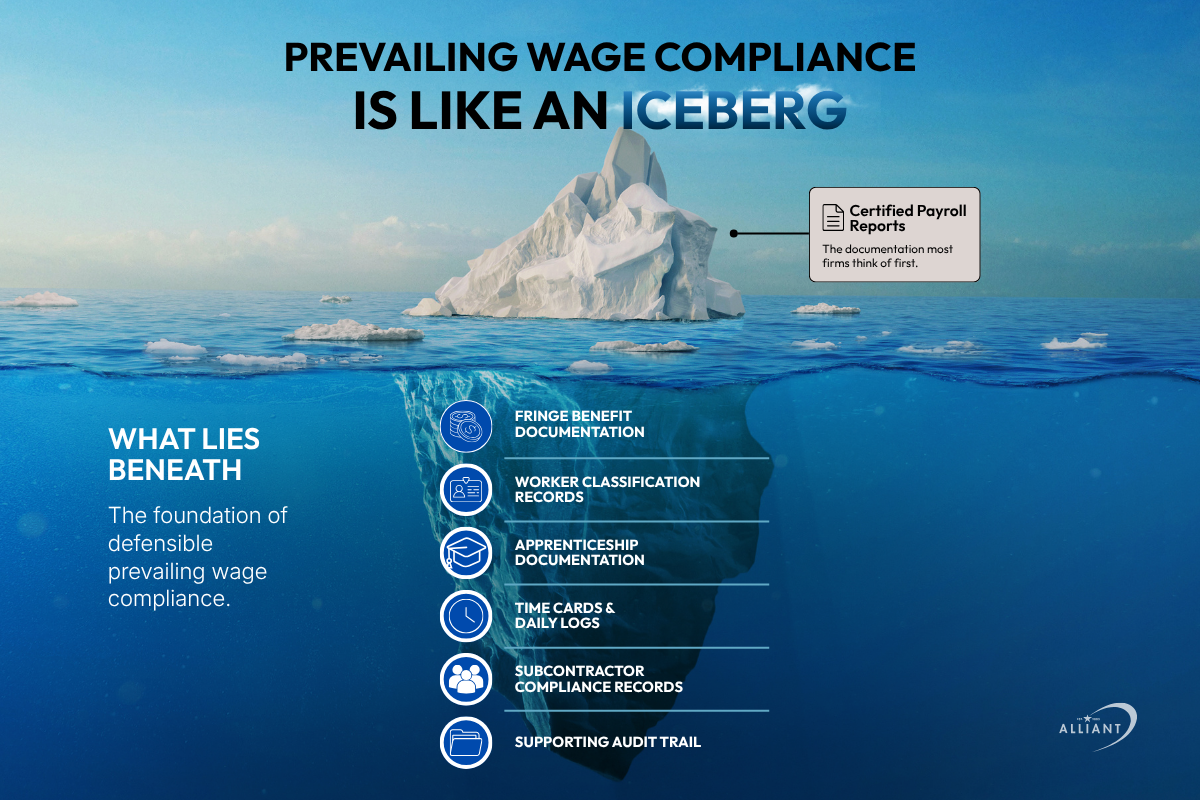
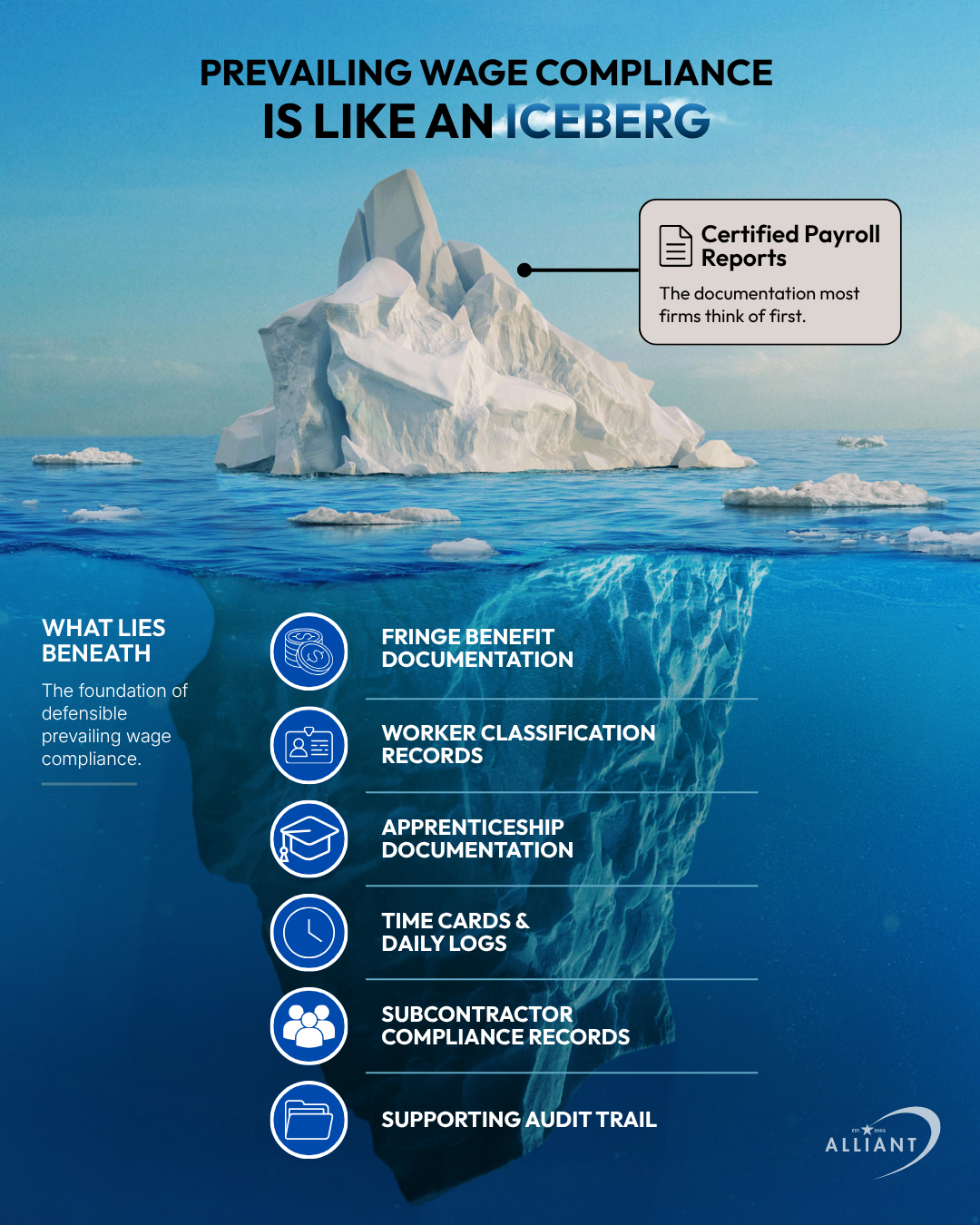
Most know that maintaining payroll records with proper prevailing wage payments is necessary to demonstrate compliance. However, certified payroll reports are only the tip of the iceberg. They summarize wages and classifications, but they don’t stand alone. In the face of a governmental audit, regulators will dig deeper, demanding the supporting documentation that validates every line item. Without it, even unintentional discrepancies can trigger penalties, withheld payments, or disqualification from incentive programs.

Infographic: Prevailing wage compliance is like an iceberg. Certified payroll reports sit above the waterline, while fringe benefit documentation, worker classification records, apprenticeship documentation, time cards and daily logs, subcontractor compliance records, and a supporting audit trail lie beneath.

Why Documentation Matters in Prevailing Wage Compliance

Think of documentation like the seatbelt in your car. Most of the time, you don’t feel its importance. The belt’s just there, quietly strapped across your chest. You might even think, “I’m careful, I don’t really need it.” But the moment an accident happens, whether it’s your fault or not, that seatbelt becomes the single most important thing protecting you from serious harm.

Supporting documentation in prevailing wage compliance works the same way. Day-to-day, it may feel like extra paperwork, especially when certified payroll reports are filed correctly. But if an audit occurs, triggered by a small discrepancy or an unintentional error, those records become your seatbelt. They’re the proof that shields your company from penalties and damage.

What paperwork do I need to prove prevailing wage compliance?

Certified payroll reports are the headline requirement, but they rely on a foundation of supporting records. Examples include, but are not limited to:

  • Fringe Benefit Records: Proof of contributions to health, pension, and training funds.
  • Worker Classification Logs: Documentation that employees are properly classified under wage determinations.
  • Apprenticeship Agreements: Evidence of compliance with apprenticeship ratios and training requirements.
  • Timecards and Daily Logs: Records that validate hours reported on certified payroll.
  • Subcontractor Compliance Records: Documentation showing that lower-tier subcontractors also meet prevailing wage obligations.

These documents are what auditors use to verify the accuracy of certified payroll reports. Without them, the report itself is just numbers on paper.

Getting Assistance with Monitoring Recordkeeping

The examples listed above help cover a big piece of the story, but the list is not exhaustive. The bigger key is ensuring that what is reported on this documentation is all verifiable across each other. When working on a project with several employees for several weeks, months, or years on end, this can be a challenging feat for firms to keep up with. Here, our team steps in to alleviate this burden to complete the review for you. We study prevailing wage and serve to protect firms in the industry from potential penalties that arise in prevailing wage law by supplying our years of experience, technology, and expert team. If you’re interested in seeking assistance with prevailing wage requirements, don’t hesitate to contact our team.

Conclusion

For all firms completing work on prevailing wage projects, compliance can come down to building a trackable paper trail that supports certified payroll reports and proves compliance under scrutiny. No matter what prevailing wage regulation is applicable on a project, supporting documentation is the seatbelt that protects your business in the event of an audit.

Categories
blog

The Hidden Risks of Ignoring Labor Compliance: Why Payroll Records Alone Won’t Save You

Introduction

Prevailing wage compliance isn’t just about checking a box—it’s a critical safeguard that ensures workers receive fair wages while protecting contractors from costly violations. Yet, one of the biggest pitfalls companies face in prevailing wage and apprenticeship compliance is the misconception that payroll records alone tell the full story.

Many businesses assume that submitting payroll records is enough to satisfy compliance requirements. But in reality, payroll records can be manipulated, contain errors, or, they can miss key information. Without supporting documentation like pay stubs, time cards, fringe benefit remittances, and other forms of verification, proving that prevailing wages have actually been paid becomes nearly impossible. This misunderstanding can lead to audits, penalties, and even legal trouble—risks that no company wants to face.

The Costly Consequences of Overlooking Compliance

Failing to properly document prevailing wage payments can result in:

  • Loss of Tax Credits/Funding – Funding earned with prevailing wage provisions within the project may be lost when prevailing wage requirements aren’t met.
  • Financial Penalties – Agencies conducting audits won’t hesitate to issue heavy fines when compliance isn’t fully demonstrated.
    • ex. IRS issues a penalty of $5,000 for each laborer or mechanic who was not paid at the prevailing wage rate in the year under the Inflation Reduction Act.
  • Project Delays or Disqualifications – Non-compliance can halt work or even disqualify companies from future bidding opportunities.
  • Legal Liability – In worst-case scenarios, businesses may face legal action for misrepresenting wage payments.

These consequences don’t fall solely on the contractors working on the project. Even if a group isn’t performing work on-site, that doesn’t mean they are exempt from adhering to prevailing wage requirements. Higher-level parties tied to a project with prevailing wage funding—such as within the IRA, for example—are liable for all penalties accrued by contractors if they are capturing IRA credits. This differs from public works projects, where the contractor is penalized directly.

Common Mistakes

In our 20+ years of experience, we have seen a wide range of mistakes. Some of the most common mistakes we’ve witnessed made on payroll records alone include, but are not limited to:

  • Incorrect Prevailing Wage Rates
  • Misclassification
  • Mis-reported Hours
  • Missing Employee Benefits
  • Unauthorized “Other” Deductions
  • Incorrect Overtime Issuance
  • Missing Statement of Compliance
  • Incorrect Project Information

When these mistakes are made, the liability varies depending on the project type. For IRA, liability would fall upon the taxpayer, whereas on public works projects, liability can come down directly to contractors. Generally, consequences can be faced at all levels, and it is upon the contractors, developers, and EPCs involved to make sure these errors are corrected, restitution is paid, and that substantial evidence is provided to prove the accuracy on the records.

Projects can last anywhere from weeks to years, and the document collection process over the course of a project should be clarified as early as possible to prevent potential back-logging of completed work. One of the largest challenges groups face is a lack of timely documentation review, as some tend to only conduct review quarterly. It’s best practice to detect non-compliance early on to prevent issues from stacking and becoming costly or difficult to resolve. Regular, proactive documentation reviews help identify discrepancies before they escalate. Establishing a clear process for document collection and compliance checks from assists with smoother project execution and minimizes the risk of penalties or delays.se, check out our video tutorial here.

Why Hiring a Seasoned Labor Compliance Firm Matters

Navigating prevailing wage requirements is complex, and missing a single critical detail can put your company at risk. A seasoned labor compliance firm ensures that your documentation is airtight—verifying every aspect of wage payment, benefits, and worker classifications to protect your company from compliance pitfalls. Here’s what an experienced compliance firm brings to the table:

Experience – Connecting with a team that’s seen it all matters. You want to know that you are aligning with people that have a track record of compliant projects and the knowledge needed to meet your needs. Having years of experience equips experts with the skills of knowing exactly what to look for and having a wealth of knowledge that can only come from time in the space.

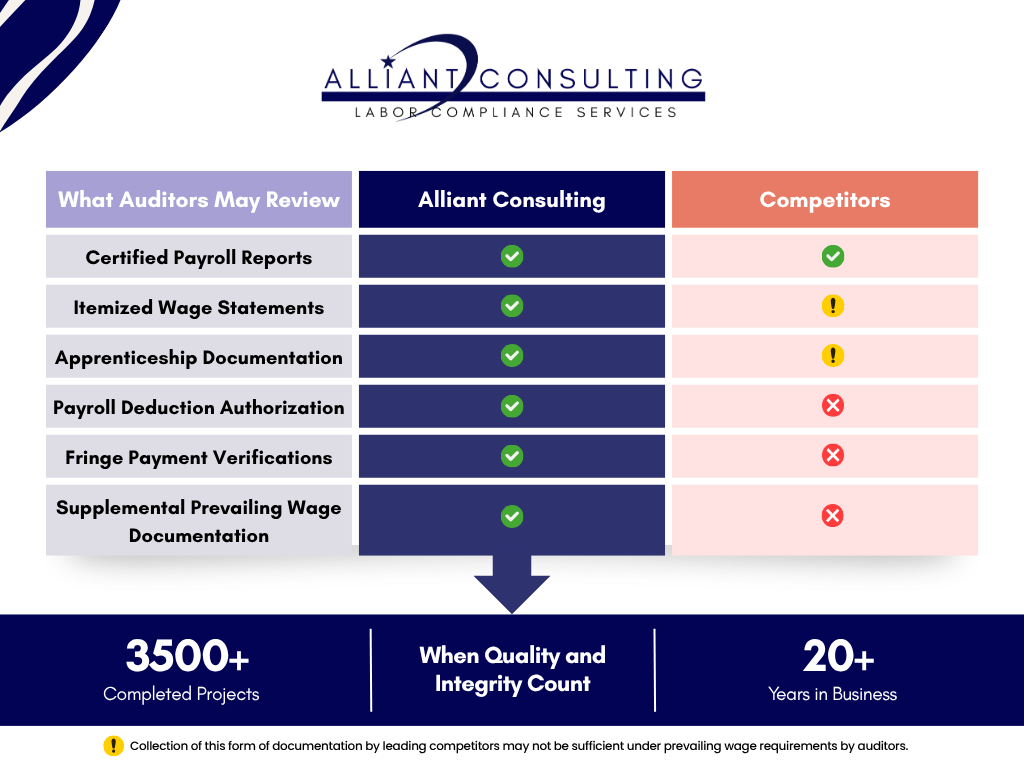
Comprehensive Documentation Review – Payroll records are just the beginning. A compliance firm verifies that the submitted time cards, pay stubs, and all cumulative supporting documentation align with reported wages. At Alliant, the documents we collect include, but are not limited to, certified payroll reports, apprenticeship documentation, itemized wage statements, payroll deduction authorization forms, fringe payment verification, and all supplemental prevailing wage documentation.

Audit Prevention Strategies – By proactively addressing compliance gaps, expert consulting firms help businesses avoid costly penalties. This assists in saving time and creates a safeguard if experts are added onto the project before it even starts.

Expert Guidance – With evolving regulations, a compliance firm ensures you’re always ahead of changes, keeping your business compliant and secure. Prevailing wage is constantly changing and can be confusing. Having a team dedicated to remaining up-to-date with prevailing wage laws to answer your questions is paramount to securing your project’s protection.

Secure Your Compliance Before Auditors Step In

Businesses that underestimate the importance of thorough compliance documentation risk financial and reputational damage. Payroll records alone don’t represent a project’s prevailing wage and apprenticeship compliance—comprehensive supporting documentation is the key to proving wages have been properly paid.

Don’t let compliance confusion put your company in jeopardy. Our team specializes in guiding businesses through prevailing wage requirements to ensure full compliance. Reach out today to safeguard your projects and avoid unnecessary risks.

Categories
blog

Misclassification

Employers are obligated by state law to classify their employees properly and pay them accordingly. While employers can misclassify employees unintentionally, misclassification is illegal and can have stiff legal ramifications. It is important to understand that workers who are misclassified are deprived of essential mandated benefits such as workers compensation if injured on the job and/or unemployment benefits.
 
One of the most prevalent instances where misclassification occurs is when employers classify their employees as independent contractors to avoid paying state minimum wage, overtime rates and payroll taxes. Investigation under these circumstances has increased; therefore, it is best practice for employers to know the difference and maintain proper records to avoid misclassification.
 
Some criteria of an Independent Contractor:

  • Run their own business
  • Paid upon completion of project
  • Provides own materials, tools and equipment
  • Work with multiple clients
  • Temporary relationship until project is completed
  • Decides when and how they will perform the work
  • Decides what work they will do

For  More Guidance on how to determine who is an employee or independent contractor under the Fair Labor Standards Act (FLSA) click here