The contents of this blog post have been transcribed from our YouTube video, “Guide Toward Davis Bacon Act Requirements & Best Practices.”
When working on a federally funded project, regulations are sensitive to keep up with. Failure to do so can result in costly penalties. Prevailing wage is a frequent standard to be in compliance with in federally funded projects, and the law that put this forth is the Davis Bacon act.
What is the Davis Bacon Act?
The Davis Bacon Act, also known as the DBA, is a rule applicable to federally funded projects that requires a minimum wage to be paid to workers, also known as the prevailing wage. This wage is consistent of a base hourly rate and fringe benefits. Alongside paying prevailing wages is the requirement to submit weekly certified payroll reports and maintain records. The Davis Bacon wages and posters should be posted on the site, easily visible to all workers. These requirements are applicable to all contractors within all tiers of the project, and penalties may be issued if in violation.
What Projects are Applicable to the Davis Bacon Act?
Applicability under the Davis Bacon Act is subject to a $2000 dollar threshold, so it is applicable to projects with a minimum of $2000 in overall project value.
The act is then in effect for the construction, alteration, or repair (including painting and decorating) of public buildings or public works. This is further defined under 29 CFR 5.2 under “Public building or public work.”
Who Is Owed Prevailing Wages?
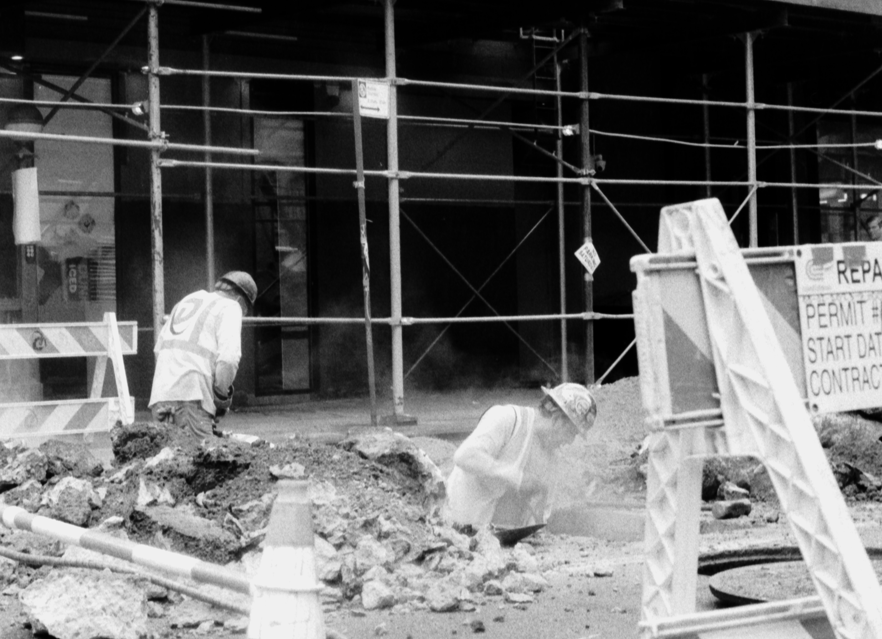
As stated, prevailing wages are the minimum amount required to be paid out to workers on this project, referred to by the Davis Bacon Act as the “laborers or mechanics.” Laborers or mechanics includes “at least those workers whose duties are manual or physical in nature” as defined by 29 CFR 5.2. So, this excludes positions such as executive, professional or clerical, those commonly seen in administrative positions. The definition does include apprentices. Prevailing wages also applies only to workers performing on the site of work.
Where do I Find the Wages for my Project?
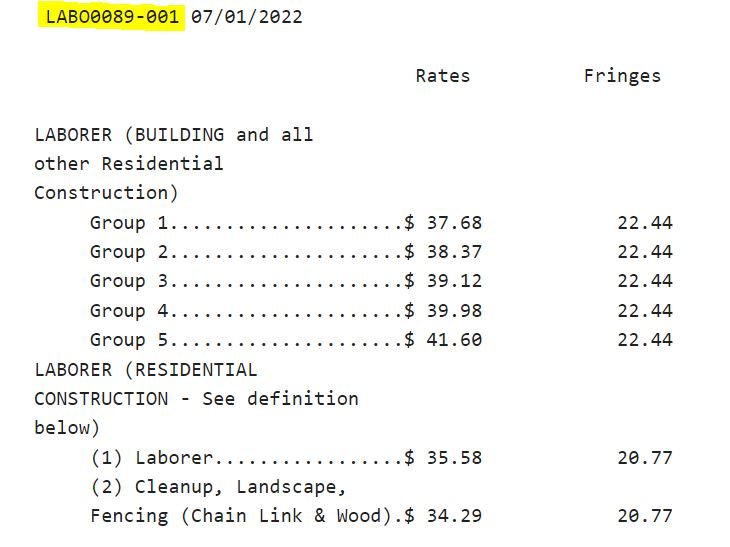
The DBA wages are posted on sheets known as “Wage Determinations” and are available online via sam.gov. The Wage Determination for your project includes a list of work titles, also known as classifications, and their corresponding wage rates.
The information you would need for your wage determination are your project’s Bid Due or Opening Date, the project County, State, and the project Construction Type.
Negotiated contracts would use the date of award. Competitively bid projects should look to the wage determination that was in effect 10 days prior to the bid opening date.
Here’s an example. Our project is competitively bid and had a bid due date of January 16th, 2024. The project is based in San Diego County, California, and has a “Heavy” construction type.
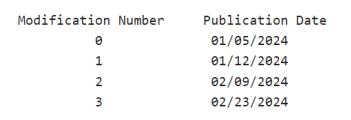
Upon inputting the applicable information onto the sam.gov site, you would click on the wage determination fit for your project. There may be multiple modifications
made. Our project had a bid due date of January 16th, 2024. Because we have to take the wage determination in effect 10 days prior to the bid due date to find our effective date.
10 days before January 16th would gives us an effective date of January 6th, 2024, which falls under Modification 0. Modification 0 is applicable for projects with effective dates from January 5th to January 11th.
If workers on your project are performing work that isn’t covered under the classifications listed on the Wage Determination sheet for your project, you have the option of submitting a SF 1444 Form, which is a request for an additional classification.
After finding your wage determination, proper wage payments should be issued to employees. While paying the base rate and fringe amount, other important things to look out for are footnotes or asterisks on your rate. This can include additional amounts required to be paid per classification or notices to changes in the rate.
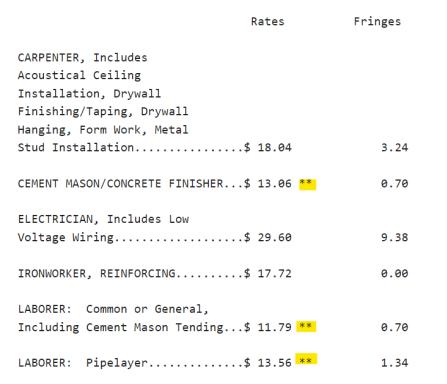
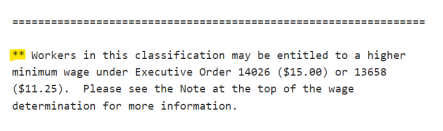
Please note, there are no general frequent increases made to Davis Bacon wage determinations, and the rate found at the beginning of the project is grandfathered in during its entirety. However, local and federal minimum wage changes are to be taken into account.
Recordkeeping Requirements
The Davis Bacon Act requires submission of Certified Payroll Reports on a weekly basis. 29 CFR 5.5(a)(3) states that payroll records must include the following: the employee name, address, social security number, correct classification, hourly rate of wages paid, daily and weekly number of hours worked, deductions, and actual wages paid. The certified payroll report must also be signed under a “statement of compliance”, indicating that all its contents are accurate and cleared by the signer. A certified payroll report template issued by the U.S Wage and Hour Division contains these requirements for payroll reporting, known as the WH347 Form.
Alongside certified payroll reports, other documentation expected to be maintain includes additional records relating to fringe benefits and apprenticeship and training as applicable. Please note, additional recordkeeping is not limited to these types of documentation. Any form of record that displays the full picture of employees’ pay, or acts as “support” toward the payroll record would go toward this requirement.
Apprenticeship Requirements
Under 29 CFR 5.2, Apprentices are defined as “helpers” that are employed and individually registered in a genuine apprenticeship program. Apprentices are generally undertaking training and developing skills to excel within their occupation. If using an apprentice on your project, you must meet the following:
1) Verify that your apprentice is properly certified by a program registered with the Employment and Training Agency’s (ETA) Office of Apprenticeship (OA), or with a State Apprenticeship Agency recognized by the OA.
2) If counting apprenticeship costs as a fringe benefit, the costs must bear a “reasonable relationship” to benefits provided to workers.
3) The costs incurred for apprenticeship must not offset costs incurred for another classification.
4) Pay the appropriate wages including the percentage of hourly rate required by the apprenticeship or training program and the approved program fringe benefits.
5) Utilize apprentices in accordance with the program-issued ratio of permitted apprentice to journeyman performing oversight.
To find the proper rates or wages to pay your apprentices, it’s best practice to consult with the program or union that you intend to utilize apprentices from to verify the rates they enforce. The Davis Bacon Act does not establish wage rate for apprentice-level workers.
Penalties
It’s vital that these requirements are met to avoid the potential penalties that come with violation. These penalties include:
1) Suspension of funds and withholding (29 CFR 5.9(a))
2) Debarment for breach of contract clauses under the requirements listed for this act (29 CFR 5.5(a)(7))
3) Restitution for unpaid wages and liquidated damages under CWHSSA (29 CFR 5.5(b)(2))
4) Withheld funds for unpaid wages and liquidated damages (29 CFR 5.5(b)(3))
Further penalties may be imposed for additional violations found, and enforcement is held by the Division of Labor in which violations are evaluated for the appropriate remedial action.
Avoid paying restitution interest, facing debarment, and encountering criminal action amongst other penalties by remaining informed and compliant with the Davis Bacon Act requirements.
Tune into the remainder of this series where we uncover updates made to the Davis Bacon Act known as the “final rule.” These updates provide context to the items we’ve discussed in today’s video and provide additional information in remaining compliant.
To get a full picture on prevailing wage, you can watch this video for a full overview. Have any further questions? Let’s get in touch.